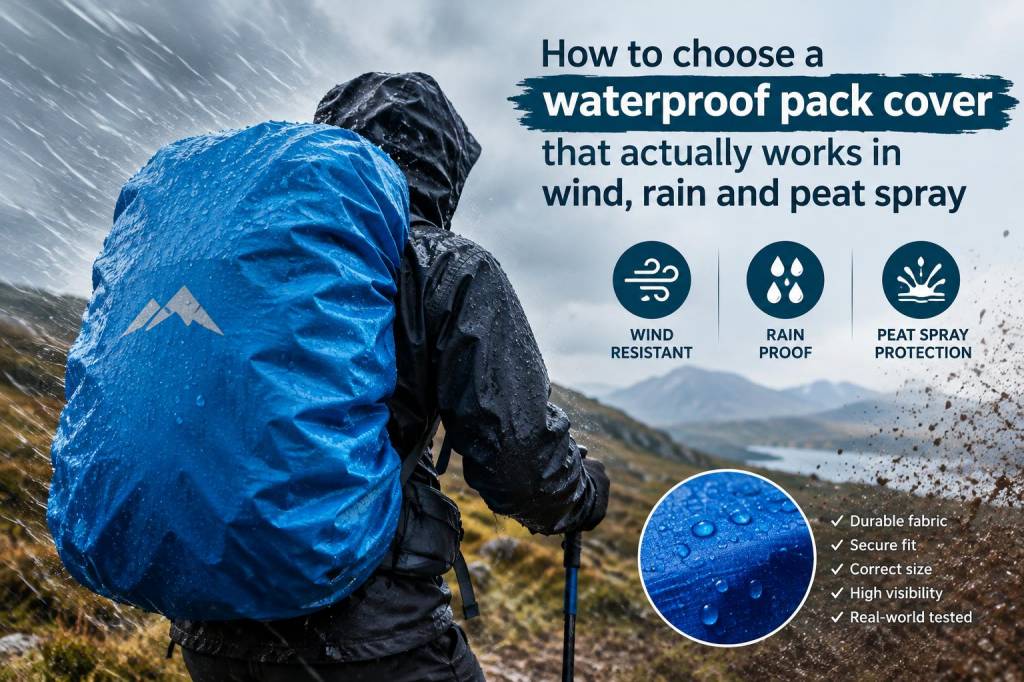
I have learned, usually after a hard day in foul weather, that a pack cover is only useful if it stays put, sheds water quickly, and does not become a sail at the first open ridge. In Britain’s wet uplands, on exposed coast paths, and across peat hags where wind drives fine spray into every seam, a pack cover earns its place only when it works in motion, not just on a shop peg. I have carried cheap elasticated covers that ballooned, shifted, and slowly leaked at the worst moment. I have also used well-made covers that barely noticed a storm. The difference is rarely luck. It is design, fit, fabric, and a clear understanding of what a cover can and cannot do.
What a pack cover is actually for
I see a lot of walkers treat a pack cover as a magic shield. It is not that. It is a layer of defence, useful when rain is persistent, when your pack is resting against wet heather, or when peat spray from a boggy crossing keeps hitting the same panel of fabric. Its main job is to protect the outer face of a pack from becoming saturated and to stop dirt and grit from working into zips and seams. If I am walking in heavy, wind-driven rain, I still want my valuables in dry bags or a liner inside the pack. A cover helps, but it should never be the only line of protection.
That distinction matters because many people buy the wrong thing for the wrong conditions. A lightweight cover may be fine for a short woodland stroll in a passing shower. It may be useless on a coastal ridge in a gale. In other words, I choose a pack cover for conditions, not for the label’s promise of waterproof certainty.
Fit matters more than any marketing claim
The first thing I look for is fit. A cover that is too small leaves corners exposed and tends to pull off when the pack sways. A cover that is too large catches the wind, flaps loudly, and can shift enough to expose the top of the pack. I want a cover that sits snugly around the body of the pack, with enough stretch to grip, but not so much tension that it feels strained every time I clip on a wet jacket or stuff in a flask.
Pack volume ratings are useful, but only as a starting point. A 30-litre cover on a 30-litre pack may fit beautifully one day and badly the next, depending on how full the pack is. A partially loaded rucksack often has awkward gaps and a narrower profile, while an overstuffed pack can become taller and harder to cover. I find it useful to think about the cover as matching real carried shape, not just the published litre count.
If I am choosing for a specific pack, I try the cover on with the pack loaded as I would carry it on a normal day. That means water, layers, lunch, gloves, and any camera gear I expect to take. A cover that fits a bare pack on a shop floor may fail the moment it meets a real hillside loadout.
Elastic edges need to grip without fighting you
The hem is one of the most important parts of any pack cover. I want a strong elastic edge that holds onto the pack body without slipping, but I also want enough give to let me fit it quickly in bad weather. On a windy crest, I do not want to wrestle with a cover that feels like a stubborn raincoat for a backpack. I want to pull it on in seconds and move on.
Some covers use a simple elastic rim, while others add a drawcord or hook system. I prefer a combination of stretch and a secure attachment point, especially if I know I will be crossing open terrain. A simple stretch rim can be fine in sheltered country, but once I am out on a wide moor, extra security helps. If the cover has a drawcord, I check whether it can be tightened with cold fingers and whether it adds real stability or just extra fuss.
Wind changes everything
Wind is what separates a decent pack cover from an excellent one. Rain alone is easy enough to manage. Wind turns a cover into a moving surface, and moving surfaces fail. I look for a cover with a cut that sits close to the pack rather than one that hangs loosely like a loose tarp. A smoother profile catches less air and is less likely to twist around the back of the pack.
I also pay attention to attachment points. Some covers include straps, buckles, or loops that help hold them in place. I have found these especially valuable on ridge walks and on days when gusts come from changing angles. A cover that is merely elasticated can sometimes rotate as I walk, especially if the pack is not evenly loaded. Once it starts to move, it tends to gather more wind and become even less secure.
If I expect strong wind, I also think about pack organisation. Dangling straps, a sleeping mat shoved under the lid, or a side pocket stuffed with a bulky bottle can all create shapes that destabilise the cover. A pack cover performs better when the pack beneath it is tidy and compact.
Rain resistance is not the same as abrasion resistance
Many pack covers use coated nylon or polyester. That is usually enough for rain, but not all fabrics are equal. I care about surface finish, because a smoother fabric tends to shed water more cleanly and is less likely to hold grime. On peat, that matters. Peat water stains everything, and once a cover has been dragged through wet moorland, a rougher fabric can cling to muck more readily.
At the same time, I do not want a fabric so thin that it tears if it brushes against heather, rock, or a gate. My own preference is for a cover that balances light weight with enough toughness to survive repeated use. A cover should not need to be delicate. It is a piece of field equipment, and field equipment should tolerate a bit of rough handling.
I also look carefully at the seams. If seams are badly finished, water can track through stitch lines even when the main fabric looks sound. Welded or well-sealed seams are usually reassuring. That said, even a very good pack cover can struggle in prolonged rain if the pack is overexposed and the wind is pushing water in from every angle. Which is why I keep my expectations realistic.
Peat spray and moorland grime need different thinking
Peat spray is a particular problem because it is not only wet. It is fine, brown, acidic, and eager to stain everything it touches. On a boggy crossing, droplets flick up from boots, tussocks, and hidden channels in the peat. I have watched covers become dirty within minutes. A dark cover hides this better, but colour is not just about appearance. It also affects visibility in poor weather.
For moorland work, I like a cover that can be wiped down easily once I am home. A slicker surface is easier to clean than a textured one. If a cover is made from a fabric that absorbs dirt into the weave, it may still perform, but it will look tired quickly and may be harder to trust over time. I also prefer a cover that dries fast after a wet, muddy day, since a damp cover packed away in a boot can start to smell and degrade faster.
I have found that peat spray makes one more thing obvious: a pack cover is not just weather protection, it is also pack care. A pack that stays cleaner lasts longer, especially around the base and lower back panel where grit tends to work hardest.
Visibility, colour, and field use
I often choose a brighter cover than I think I need. In poor light, on a dark hillside, or near a road crossing, visibility matters. A bright cover can make it easier for other walkers, cyclists, drivers, or a companion to spot me. This is especially useful in mist, driving rain, or winter dusk. I still like earthy colours for some settings, but I do not treat visibility as a luxury feature.
Colour can also help with practical use. In a mixed group, a bright cover makes my pack easier to identify if it is set down beside others. It sounds trivial until I am taking a break in rain and want to grab my own kit quickly. Small practicalities matter when conditions are poor and fingers are cold.
Features I value and features I ignore
I care less about flashy extras than many buyers do. A built-in storage pocket is not essential. Reflective details can be useful. A stuff sack is nice, though I usually end up folding the cover directly into a side pocket or lid space. What I value most is simple reliability.
- Secure elastic that grips without slipping
- Close cut that reduces wind drag
- Tough but light fabric that handles brush and grit
- Reasonable seam quality for wet-weather use
- Easy cleaning after peat and mud
- Fast deployment when rain arrives suddenly
What I usually ignore are oversized claims, decorative patterns, and vague promises of complete weatherproofing. If a product description sounds too absolute, I become cautious. In the hills, nothing stays perfect for long, and gear should be judged by repeated use rather than a single impressive claim.
A simple comparison I use before buying
| Feature | What I want | What causes problems |
|---|---|---|
| Fit | Snug on a loaded pack | Loose fabric that shifts in wind |
| Hem | Strong elastic with secure hold | Weak stretch or awkward tightening |
| Fabric | Smooth, tough, quick drying | Thin cloth that tears or holds grime |
| Seams | Neat, sealed, durable | Water seepage through poor stitching |
| Wind performance | Low profile, stable shape | Flapping, twisting, lifting |
| Moorland use | Easy to clean after peat spray | Staining and slow drying |
What I carry inside even with a good cover
Even when I trust my pack cover, I still protect key items separately. That usually means a dry bag for spare clothing and another for electronics or paper notes. My map may go in a pocket or a waterproof sleeve. Snacks, gloves, and a headtorch often end up in smaller pouches. This layered approach matters because a pack cover does its job on the outside, but inside the pack there are always weak points: zip openings, seam lines, and the occasional clumsy moment when a pack is opened in rain.
I also keep in mind that a pack cover can cause false confidence. If I throw a damp jacket into a wet pack and rely on the cover alone, I have already lost the argument with the weather. A good cover supports a broader system of care, not a single heroic fix.
When I am choosing one for real use, I picture the exact places I will walk: a hard west wind on an exposed headland, rain sweeping across a forestry track, or a heavy peat shower rising from a sodden moor. A cover that works in those moments is usually one that fits neatly, grips firmly, stays calm in gusts, and cleans up easily after a muddy day in the hills.