A peat hag can look solid enough from a distance, especially when I am moving across open moorland in poor light or in a brisk wind that keeps my attention on balance and route rather than on every step. Then, without much warning, the edge gives way. One foot sinks, the surface slumps, and what felt like firm ground becomes a soft, broken drop of wet peat, heather roots, and hidden water. I have had that moment more than once, and each time it has reminded me that peatland is not just a surface to cross but a living, shifting landscape that asks for patience and respect.
When a hag collapses underfoot, my first job is not to stand up quickly and carry on as if nothing happened. My first job is to stop, breathe, and read what has happened to my body, my kit, and the ground around me. A small collapse may only leave me muddy and annoyed, but it can also twist an ankle, soak a boot, damage a pole, or leave me exposed to a deeper sink if I rush my next move. In blanket bog, careless recovery can turn one mistake into two.
What I do in the first few seconds
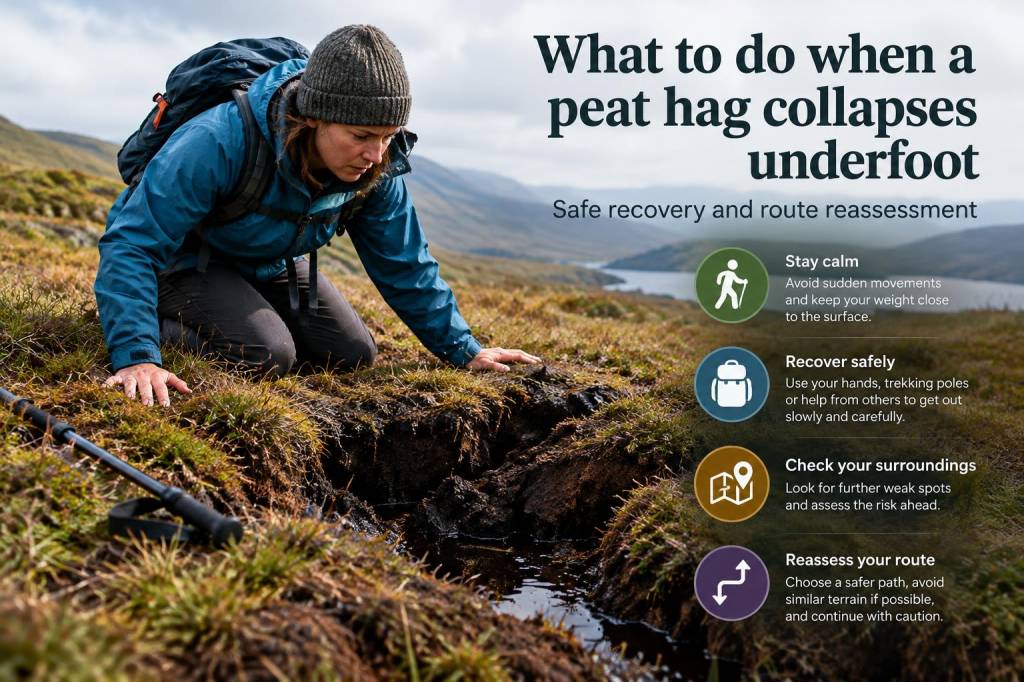
I freeze before I try to pull my foot free. That pause matters, because sudden movement can widen the hole or drive the other leg into unstable peat. I keep my weight as low as I can, often dropping onto one knee or sitting back carefully if the surface still feels uncertain. If I have poles, I use them for balance, but I do not jab them hard into the peat as if it were rock or turf. A pole can vanish surprisingly deep, and an overcommitment can make me topple.
I check whether I am actually trapped or only momentarily unsupported. Sometimes the foot has punched through a thin crust and is resting in a pocket of softer material. In that case I shift my weight very slowly, testing the direction that releases pressure without tearing the ground further. If the collapse has exposed a deeper cavity, I resist the instinct to wrench my boot out in one quick pull. Instead, I work the leg free with small movements, keeping my centre of gravity low and my hands braced on firmer ground if possible.
If I feel pain, sharp instability, or any sign that I may have twisted something, I stop trying to be heroic. A peat hag may be inconvenient, but a damaged ankle or knee far from a path can become a serious problem. On remote ground, pride is a poor rescue plan.
Reading my body and my equipment
Once I am clear, I do a quick personal check. I look at the joint that took the force, and I flex it gently before putting full weight on it. I listen for the kind of pain that changes a simple slip into a route-ending injury. If I can walk a few slow steps without limping heavily, I know I may continue with care. If I cannot, I reassess immediately and start planning a slower exit.
I then check my kit in a practical order. A wet boot can make a long day miserable, but more importantly it can hide damage. I look for torn gaiters, mud packed into the rand, a bent trekking pole tip, or a shoe that has begun to separate. On peatland, I have learned that a small problem can become a repeated one if I ignore it. A boot with a compromised sole can slide on slick sphagnum. A pole with a bent section can fail when I need it most.
My phone, map, and compass are next. If I have fallen into a wet section, I want to know whether those essentials are still dry and usable. I keep them in places that reduce risk, but peatland has a talent for finding weak spots in any system. If something is wet, I do not assume it is ruined. I separate the items, dry them when conditions allow, and keep moving only when I know I can still navigate safely.
Why peatland collapses are different from ordinary slips
Peat hag collapse is not the same as slipping on a muddy path or stepping off a rock. The ground itself can fail, and that changes everything. A hag is often the eroded face of a peat bank, with undercut edges, saturated material, and hidden voids. Even when the top looks thick and grassy, the structure beneath may be weak. I treat the area as unstable until I have a very good reason not to.
That is why I avoid instantly stepping onto the nearest higher bit of ground. The visible edge may simply be another thin shell over soft peat. Instead, I look for signs of more reliable footing: firmer mineral soil, well-used path lines, rocky ribs, or areas where vegetation is more compact and less broken. Even then, I test each move carefully. In wet uplands, a safe step is often the result of observation, not luck.
I also remind myself that peatland damage can spread. If I thrash around, I may break the edge further and create a wider scar. Slow, controlled movement protects both me and the habitat. I think of it as part of walking responsibly rather than an inconvenience to be endured.
Route reassessment after the incident
After I have recovered from the immediate moment, I reassess the whole route. That means asking a simple question: is the original line still the right line? Sometimes the answer is yes, but with greater care. Other times, the answer is no, and I need to change course while conditions are still manageable.
I study the ground ahead for repeated signs of weakness. If one hag has failed under my weight, similar edges may be close by. I look for water sheen, fresh cracks, sagging turf, tramlines of erosion, and any section that forces me to choose between multiple unstable placements. If the terrain is becoming more broken, I do not wait for a second collapse to tell me I should leave.
I also consider weather and fatigue. Peatland in dry, stable weather may offer enough structure for careful travel, but in rain, mist, or wind, every judgment becomes harder. If I am already tired, my foot placement becomes less precise, and the cost of a mistake rises. A route that looked fine on the map can become a poor idea after a collapse because my confidence, rhythm, and attention are all disturbed.
When I need to change course, I do it deliberately. I do not drift aimlessly across the moor hoping to find something better. I identify a safer line, even if it means a longer walk, a slower pace, or a less elegant finish. On peatland, distance is less important than stability. A direct line that keeps collapsing is not efficient, only reckless.
What I use as safer movement choices
| Situation | My response | Reason |
|---|---|---|
| Fresh collapse at a hag edge | Pause, lower my centre of gravity, and free the foot slowly | Reduces further breakage and limits strain |
| Pain after the slip | Stop, assess movement, and avoid forcing the joint | Prevents a minor twist from becoming a major injury |
| Repeated weak ground ahead | Shift to firmer terrain or abandon the line | Limits repeated collapse and habitat damage |
| Wet or damaged kit | Inspect, dry, and separate essential items | Protects navigation and safety equipment |
| Low visibility or rising fatigue | Slow down or reroute early | Improves decision-making and reduces risk |
How I recover without making the situation worse
Recovery is partly physical and partly mental. Physically, I want to stand with as much control as possible, place each foot on the firmest available patch, and avoid twisting through the ankle or knee. Mentally, I want to resist the little burst of embarrassment that can make me hurry. That emotion is familiar to anyone who has stumbled in public or in front of companions, but peatland punishes haste more than it punishes humility.
If I am with others, I say clearly what happened and what I need. I prefer plain words: I have sunk, I need a moment, I want to check my ankle, or I need to change the line. Clear communication prevents somebody else from walking into the same weak spot. It also helps the group stay calm. I have found that a short, steady explanation does more good than a flustered attempt to laugh it off.
If I am alone, I talk myself through the process. That may sound simple, but it helps me remain methodical. I name the task: release the foot, check the joint, find the firmer line, confirm the map position. The peat hag has already given me one surprise; I do not need to add confusion to it.
What I pay attention to afterward
Later in the day, I pay attention to any delayed pain or stiffness. A twist that feels manageable in the moment can tighten up after a mile or two. I also watch for cold, especially if my socks and boot have taken on water. A wet foot inside a wind can turn a manageable outing into a long, draining one. If conditions are poor, I may stop earlier than planned simply to preserve body temperature and judgement.
I make a note of where the collapse occurred and what the ground looked like. Over time, these observations improve my route choices. I learn where erosion is active, where edge lines are deceptive, and where seasonal changes make a familiar crossing less trustworthy. This is one reason I value repeated walks across the same landscapes: they teach me that peatland is never static, and that confidence must always be revised by current conditions.
When I return to a place like that, I move with more respect for the surface and more attention to the signals under my boots. A peat hag collapse is an unwelcome interruption, but it is also a very clear lesson. The landscape is telling me something about support, vulnerability, and the need to keep reassessing every step as I go.