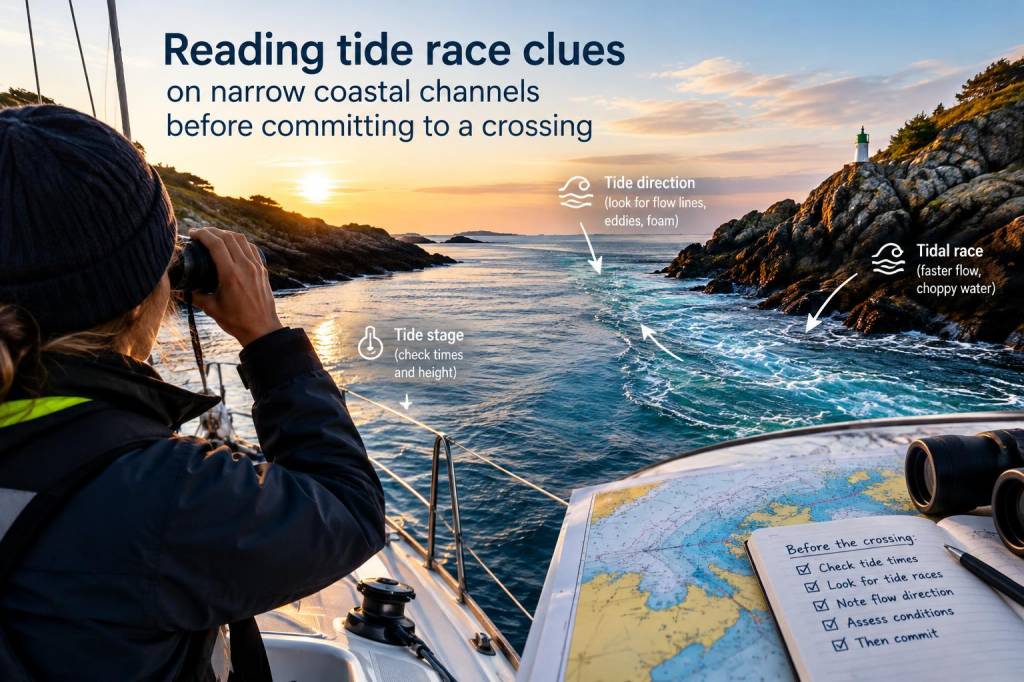
I have learned to treat narrow coastal channels with real respect. They can look calm from a ridge path or a shingle spit, yet hide some of the most deceptive water on the coast. A tide race is not just fast water; it is moving water being forced through a constriction, and that pressure can turn an ordinary crossing into something far more serious. Before I commit to a crossing, I slow down, watch, listen, and read every clue I can gather from the shore, the sea surface, and the land around me.
What I look for before I even step closer
My first check is always the shape of the channel itself. A narrow gap between headlands, a river mouth with a rocky throat, or a cut between islands will often funnel flow into a stronger current than I expect from looking at a tide table alone. I ask myself whether water has room to spread out, or whether it is being squeezed between hard edges. If I can see a smooth bay on one side and a tight pinch point on the other, I know the pinch point deserves special attention.
I also look at how the current meets the land. A tide race often announces itself by white streaks, short standing waves, or lines of broken water where the main flow collides with submerged rock, a reef, or a change in depth. If the surface is polished in one place and chaotic in another, that contrast matters. Even on a relatively small channel, those patterns can tell me more than a timetable alone.
On rocky coasts, I pay close attention to any outcrops just under the surface. A submerged ridge can break the water into turbulent, aerated flow long before the channel is fully flooded. In those moments, a crossing that looks short may still demand patience, because the problem is not distance, but control.
Clues from the water surface
Surface texture is one of my most useful indicators. I trust my eyes on three main signs: standing waves, whirlpools, and disorganised chop. Standing waves hold position because the current is pushing against a fixed obstacle. Whirlpools suggest that water is folding back on itself. Chop that seems to come from several directions at once can mean cross-currents are interacting in a confined space.
I also watch for foam lines. Foam can gather along shear zones, revealing where one stream of water is moving faster than another. When I see a foam line curving sharply into the channel, I know there may be a current seam beneath it. Those seams can matter a great deal if I am using a small boat, crossing on foot at low water, or edging along a narrow shore where a slip would be costly.
Another clue is the sound. A tide race often has a different voice from open water. I listen for a steady roar, a low rumble, or an irregular hissing as waves break over hidden shallows. On quiet days, that sound can travel farther than I expect. If I can hear the water working harder than the wind should explain, I pause and look again.
What I read from the tide, not just from the clock
I never trust a single low-water or high-water time on its own. I want to know whether the tide is still rising, still falling, or near slack water, because narrow channels can behave very differently at each stage. A crossing that is safe at slack may become awkward within minutes if the current starts to gather strength. In some places, especially where the channel shape is uneven, the strongest flow arrives well before or after the nominal time I expected.
Spring tides deserve particular caution. Higher tidal range means more water moving in and out, and more energy forced through narrow gaps. A channel that is manageable on neap tides may become noisy and intimidating a few days later. I have seen plenty of walkers underestimate this because they looked only at the height of the tide, not the speed of the moving water.
Wind direction matters too. A wind blowing against the tide can steepen the surface and build short, confused waves. Even if the current itself is not extreme, that opposing wind can make a crossing feel much more unstable. If the tide is flowing one way through a tight channel and the wind is pushing in the opposite direction, I treat the whole area as more demanding than the chart might suggest.
Questions I ask myself before I commit
Before I step off, I run through a set of simple questions in my head:
- Can I clearly see both sides of the crossing?
- Is the water surface calm enough for my chosen route?
- Are there signs of standing waves, back eddies, or submerged obstacles?
- Is the tide still moving, and if so, in what direction?
- Would a change in wind make this much harder within the next hour?
- Do I have a safe retreat if conditions deteriorate?
If I cannot answer those questions with confidence, I do not cross. I would rather wait for a safer window than gamble on a narrow margin. That is not caution for its own sake; it is a habit built from watching coastlines change character much faster than people expect.
How I judge whether a crossing is realistic
A realistic crossing is one where I can match the conditions to my own ability, my equipment, and my escape options. If I am on foot, I want a route that stays within my competence if footing becomes slippery or if I need to turn back. If I am moving near watercraft or crossing where a ferry service once operated, I want to know whether local knowledge still holds true today. Coastlines shift, channels silt, and a route that worked last season may not behave the same way now.
I also think about visibility. Poor light makes it much harder to read texture on the water. Early morning glare can hide detail, while a low evening sun can make wave patterns appear flatter than they are. If I arrive and cannot read the surface clearly, I do not pretend that the crossing is simple. I wait until I can see it properly.
In areas with strong tidal streams, I prefer to watch from a raised point first. A clifftop, dune crest, or harbour wall can give a broader view of current lines and reveal whether the race is tightening or easing. That wider perspective often stops me from making a lazy assumption based on one small patch of water.
Local knowledge and recent observation
Charts and tide tables matter, but local knowledge often gives the missing context. A fisher, harbour worker, coastal ranger, or long-distance walker may know about a reef that is barely marked, a seasonal change in flow, or a place where the current accelerates around the turn of the coast. I value that information highly, especially in unfamiliar areas.
Recent observation matters just as much. Even if I have crossed a channel before, I still watch it on the day. Fresh wind, recent storms, spring debris, or shifting sandbanks can all alter the way water behaves. A crossing I completed safely six months ago is not proof that today will be the same.
I have also learned to respect the ordinary signs of impatience in myself. If I am eager to keep moving, I am more likely to ignore small warnings. When that happens, I make myself stop and scan again. A tide race does not reward haste. It punishes assumptions.
Gear and habits that help me stay sharp
Good route reading starts with attention, but a few practical habits help me stay honest about what I am seeing. I keep navigation tools ready, carry spare layers, and make sure my phone or GPS device is protected from spray. I also prefer footwear that gives me stable grip on wet rock and uneven ground, because tired feet make poor judgments.
My personal habit is to take a few minutes before crossing to mark landmarks in my mind. I note the alignment of rocks, posts, or headland shapes so I can tell whether I am moving at the intended angle and whether the water is pushing me sideways. In a narrow channel, that small bit of mental mapping can prevent a lot of trouble.
| Clue | What it may mean | My response |
|---|---|---|
| White water over a fixed line | Submerged rock or reef forcing turbulence | Hold back and study the pattern from a safer angle |
| Curving foam seams | Shear zone between currents | Assume the flow is uneven and may pull sideways |
| Short standing waves | Strong current meeting an obstacle or depth change | Check for hidden hazards before committing |
| Increasing roar or hiss | Current strengthening or breaking over shallows | Reassess timing and consider waiting |
| Wind against tide | Steeper, more confused surface | Expect harder conditions than the tide table suggests |
What I do when I am uncertain
When I am uncertain, I do not try to force a neat answer out of the landscape. I step back, watch for a full tidal cycle if I have time, or choose a different route. Some of my most satisfying coastal days have come from changing plans at the last moment and finding a safer, richer path along the shore. The coast usually offers another way if I stay flexible enough to see it.
If a crossing still seems possible but marginal, I give it more time. I wait for a quieter phase, check the surface again, and compare what I see with the tide stage I expected. Often, that patience reveals whether the channel is easing or gathering power. In a narrow coastal gap, that difference can decide everything.
When I finally do cross, I keep watching until I am clear of the influence of the flow. Conditions can change quickly, and a tide race may extend farther than it first appears. I do not relax just because I have left the narrowest point behind; I keep my eyes on the water until I am on stable ground and certain that the channel is no longer shaping my path.