Guides

How to cross a collapsing cliff path safely: signs to watch and emergency steps

How to cross a collapsing cliff path safely: signs to watch and emergency steps

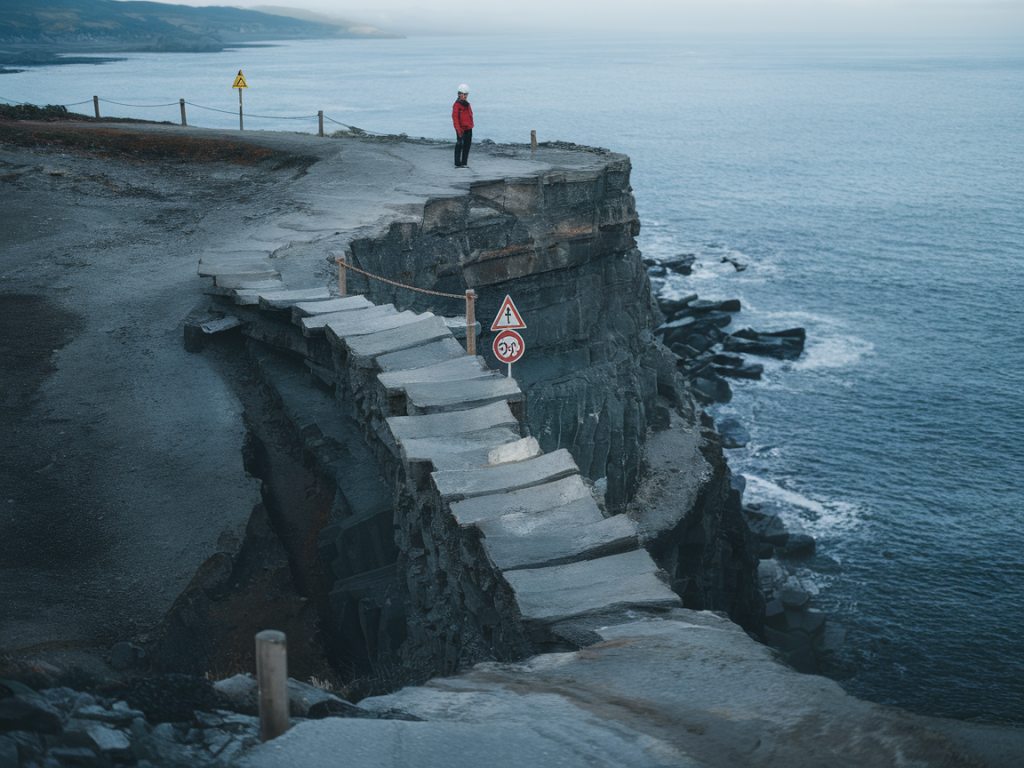
I've followed a lot of cliff paths over the years: some smooth, some nervous, and a handful that have ended in that hollow, unstable crunch that tells you the ground beneath your feet is giving way. Crossing a collapsing cliff path is one of those situations you hope never to face, but if you walk Britain's wild edges often, it's a risk worth preparing for. Here I share what I look for on approach, how I make safe decisions, and the immediate steps I take if a path starts to fail beneath me.

Reading the cliff before you step

Before you even consider crossing a narrow cliff-top path, take a moment to stop and observe. I’ll often pause a good 20–30 metres back, turn my body so I can view the line of the path and the cliff face beneath it, and use my binoculars or camera telephoto to scan for subtle signs of instability.

Key signs I watch for:

  • Recent collapses or fresh scarp faces — exposed soil with a clean break, boggy turf hanging over air, or vegetation abruptly ending;
  • Cracking or sagging turf — hairline cracks, steps or undulations down the path indicate progressive failure;
  • Slumped or blocky material at the cliff base — fallen chunks piled at the bottom mean the cliff is actively eroding;
  • Water saturation — seepage zones, spring lines or saturated ground above the cliff increase collapse risk;
  • Vegetation patterns — trees or shrubs leaning away from the edge, or bare root plates exposed;
  • Recent storms or high tides — if the coast has been hammered in the last days, expect increased instability.
  • If more than one of these signs is present, I treat the section as suspect and look for an alternative. The best decision is always to avoid walking the compromised line entirely.

    Deciding whether to cross

    Decision-making is mostly about risk versus reward. Ask yourself: how narrow is the path? How far above the drop is it? What’s the consequence of a slip? I use a simple mental checklist:

  • Width: can two boots fit side-by-side on firm ground? If not, consider turning back.
  • Terrain below: beach, rocks, or sheer drop? Softer beaches are less lethal than jagged rocks, but tides matter.
  • Escape options: are there obvious pull-back points if the path fails part-way?
  • Conditions: wind, rain or fading light can transform a marginal path into an unsafe one.
  • When in doubt, I choose the conservative option. You can always find another route or come back with a safer plan. On several occasions I’ve walked several hundred metres inland and found a safer way along a field edge or farm track that avoided the worst of the cliff.

    How I cross a narrow or suspect cliff path

    If I determine the crossing is acceptable, I treat it like a short exposed scramble. My movements are slow, deliberate, and I use a few simple techniques to reduce the chance of triggering collapse or losing my balance:

  • Test before committing: probe the ground ahead with a trekking pole. If the pole sinks unusually deep or the surface slumps, that’s a warning.
  • Keep weight central: I walk with my feet under my hips and avoid leaning toward the cliff edge. If carrying a pack, I tighten the hipbelt to keep weight distributed.
  • Low centre of gravity: I sometimes bend my knees slightly and, on very narrow sections, I will sit and scoot to keep the centre of gravity lower.
  • One step at a time: avoid launching or dynamic moves. Each foot placement is deliberate and checked.
  • Face the slope if necessary: on very steep or crumbly turf I’ll face the slope and sidestep, keeping three points of contact with the ground where possible.
  • Avoid the edge: keep to the landward side of the path. The seaward margin is often the most undermined.
  • On icy or muddy days I use microspikes (I’ve used Kahtoola MICROspikes) and alpine-style gaiters to maintain traction. A pair of lightweight trekking poles (Black Diamond Trail Pro, for example) is indispensable — they extend your balance points and allow you to probe for voids below the turf.

    What to do if the path starts to collapse under you

    There’s an instinct to move quickly away from a crumbling edge, but panicked, fast moves often worsen the situation. If the ground begins to fail beneath you, follow these steps:

  • Stay low: drop to a sitting position immediately if possible. This lowers your centre of gravity and reduces the chance of rolling over the edge.
  • Move inward, not outward: do not step toward the cliff; instead, shuffle or scoot your heels toward firmer ground. If you can keep facing the land, you can better judge solid turf.
  • Use poles or hands to distribute weight: spread your weight to reduce pressure on the failing section — both poles planted landwards and palms on firmer turf help.
  • Call for help early: if you have a phone and reception, call 999/112 and request the coastguard if you’re coastal. Give clear grid references or use What3Words; tell them you’re on a collapsing cliff path and describe your location relative to known landmarks.
  • Avoid sudden leaps: jumping down to a lower ledge can cause more collapse or injury. Only jump if the lower surface is clearly safe and the drop is within your capability.
  • I once watched a piece of turf peel away like the edge of a carpet beneath a partner while we were photographing a nesting fulmar. He sat down, kept weight back, and shuffled inland on his bum; it was the easiest and safest move. Quick thinking and a calm voice helped more than strength.

    If someone falls or becomes stranded

    If you witness someone slip over the edge or become stranded on a fallen ledge below, call the coastguard immediately and provide as much location detail as you can. Do not attempt a rescue that puts you at equal risk — cliffs are a frequent cause of lethal secondary accidents.

    Actions I take while awaiting professional rescue:

  • Maintain visual contact: keep the casualty in view and talk to them to maintain consciousness and reduce panic.
  • Throw a floating line or a buoyant aid if safe to do so: on lower cliffs with water below, a throwline can help, but only if you are on firm ground and confident of the target.
  • Keep spectators back: collapse can spread; crowds on the cliff top worsen the problem.
  • Kit to carry that improves safety

    Over the years I’ve refined a short “cliff-aware” kit list that I tuck into my daypack:

  • Trekking poles: for probing and balance.
  • Lightweight helmet: in particularly crumbly coastal sections I’ll use a climbing-style helmet (Petzl or Black Diamond) during rope-access photography or very exposed moves.
  • Microspikes: for icy or muddy margins.
  • Whistle and headtorch: signalling and light if you get benighted.
  • Fully charged phone + power bank: and offline maps (OS Maps) or What3Words installed.
  • Basic first aid kit: include sterile dressings and a space blanket.
  • High-visibility waterproof jacket: useful for signalling and staying warm if you’re static.
  • Working with landowners, paths officers and coastguard

    If I discover a dangerous section of path, I report it. Local councils and National Trails teams need that intel to place signs or close lines. I take photos, note OS grid refs, and contact the local authority or the National Park. If there’s immediate danger, call the coastguard; they can coordinate cliff rescue teams and issue public warnings.

    One of the best actions any walker can take is to plan ahead: check local access updates, read tide tables on coastal walks, and allow extra time so poor light doesn’t force risky decisions. Nature on the edges is dramatic and changeable — that’s the draw — but respect for the forces shaping that drama keeps us walking another day.

    You should also check the following news: