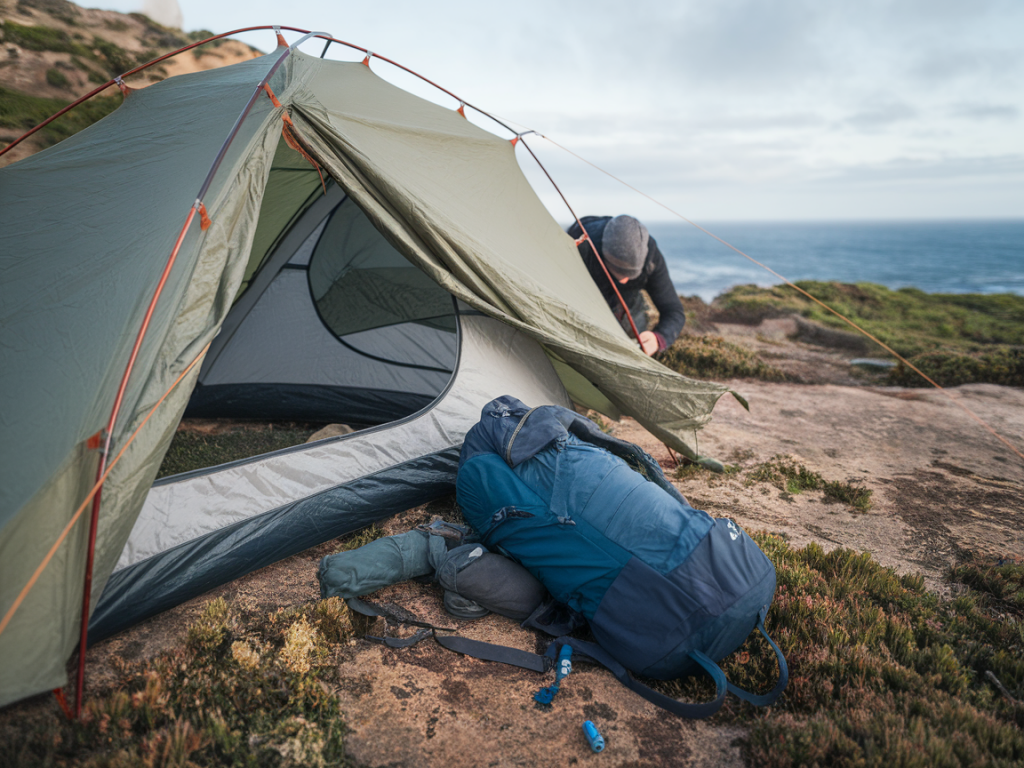
I’ve stood on more than one exposed headland with a shredded tent fly or a rucksack strap dangling uselessly and that knot-in-the-stomach question — do I try to fix this here, or do I accept defeat and get off the hill? — is one I’ve learned to answer quickly. The difference between a long, cold night and a safe walk home often comes down to a few small repairs and the confidence to know when a fix will hold until you get back to civilisation.
First assessment: can it wait?
When something fails on a windy headland, the first step is always to stop, shelter from the worst of the wind, and make a calm assessment. Ask yourself:
- Is the damage structural? A broken tent pole or snapped rucksack frame is a structural failure. A burn hole, torn guyline, or a broken zip pull might be annoying but not necessarily trip-ending.
- Can I make a temporary fix that will hold for the walk out? If a repair will hold for a few hours in wet, windy conditions, it’s often worth doing on the spot.
- Do I have the kit and skills to make that fix? Simple survival items like duct tape, zip ties and a needle and thread can solve a surprising number of problems.
I carry a small repair kit and have used it enough times that I now can tell, more often than not, whether I'm patching to get home or patching to continue a trip. One ruined tent does not ruin the whole walk — but a failed repair on a cold, wet evening can make things much worse.
Essential items for your repair kit
Pack these and you’ll cover 90% of likely failures:
- Strong duct tape (folded onto itself for easier use)
- Tenacious Tape or Nikwax Fabric & Gear Tape for fabrics
- Needle and waxed thread or a small sewing awl
- Spare guyline cord (6–7mm dynamic cord or 2–3mm accessory cord)
- Zip ties and safety pins
- Repair splint (carbon fibre pole splint or a section of tent pole)
- Small multi-tool with pliers
- Replacement buckles or a few metres of webbing
Tenacious Tape is my go-to for fabric tears — it’s lightweight, sticks to damp fabric better than most tapes, and takes stitches well. For quick waterproofing on a taped seam or patch, a few dabs of seam grip or silicone sealant will do the job until you can re-sew properly.
Tent fixes on a windy headland
These are the failures I see most often — and how I handle them in the field.
Broken pole
When a pole snaps, the tent loses its shape. If the break is clean and you have the broken section, you can often splice it with a sleeve.
- Find a splint: use a tent pole ferrule, a section from a spare pole, or even a plastic water bottle cut to size as a temporary sleeve.
- Insert the splint into the broken ends and secure with tape, then lash with cord or a zip tie. Align the pole before you tension the fly.
- For severe damage, pitch the fly without the pole, tension it low to the ground and create a lean-to with trekking poles if you have them.
Torn fly or floor
Small tears can be taped, but on a windy headland you need a reliable patch.
- Clean the area of grit and moisture as best you can.
- Apply Tenacious Tape to the inside first, then the outside if possible. Press firmly and allow a few minutes before tensioning the fabric.
- Sew a few reinforcing stitches through the tape if you have a needle and thread — that combination is immensely strong.
Guyline failure
A snapped guyline can quickly turn an otherwise stable tent into a hazard in wind. Replace with accessory cord and use a figure-of-eight or double fisherman's knot. If you don’t have replacement cord, strip lengthwise a section of webbing from a non-essential pack strap and use that — it’s surprisingly effective.
Zip problems
A stuck or broken zip on your tent door can be maddening in rain and wind. If the slider has popped off, you can often use pliers to squeeze it back on the teeth. Failing that, run a length of cord through the remaining teeth and tie it off — you won’t get a full closure, but you’ll keep most of the wind and rain out.
Rucksack repairs to get you home
A rucksack can fail in ways that make carrying your kit impossible. I’ve patched shoulder straps and replaced buckles on the go more times than I care to count.
Broken buckle or clip
Zip ties are the simplest fix. Thread the strap through the broken buckle and secure with a zip tie; for a more permanent repair, replace with a small, inexpensive ITW Nexus buckle. Spare buckles are tiny and light — worth carrying if you regularly go into remote country.
Damaged webbing or strap
If a strap is frayed or sliced, you can shorten and re-stitch it using a sewing awl or needle and heavy thread, or replace it with cord for the duration. In gale conditions I’ll clip the offending strap to a secondary anchor point on my pack to distribute load and avoid further tearing.
Frame failure
Broken frames are tricky. If the pack’s frame is just bent, you can lumber it with a paddle of plastic or split a trekking pole and lash it in place. If the frame is shattered and the pack can’t carry weight, consider ditching non-essential items or rearranging your load to wear less structure-dependent weight higher on your back.
When to abandon the repair and replace
Sometimes the right choice is to accept the loss and get off the hill. Replace when:
- The structural integrity is irreparably compromised (a tent with multiple pole breaks and large tears in sustained gale).
- Your temporary fix would introduce a serious safety risk (e.g., a pack frame that could fail on steep, technical terrain).
- The weather forecast or the remoteness of your location means a marginal repair won’t be enough to keep you safe overnight.
| Problem | Temporary fix on trail | Replace before next trip? |
|---|---|---|
| Broken pole | Splint with sleeve + tape; use trekking poles | Yes — poles are mission-critical |
| Torn fly | Tenacious Tape + stitches | Depends on size — replace if large or multiple tears |
| Zip failure | Squeeze slider back, or use cord as closure | Usually — zips affect usability |
| Buckle/strap damage | Zip ties, re-route webbing, temporary stitching | Replace if load-bearing |
On headlands, conditions change fast and a marginal fix can become a failure if the wind freshens. My rule is to favour options that minimise risk: if a repair leaves me with a tent or pack that will withstand a severe squall, I’ll use it; if not, I prioritise getting to shelter or heading off the high ground.
Post-trip repairs and upgrades
Back home, don’t leave repairs as “maybe” jobs. Re-stitching seams properly, ordering replacement poles from MSR or Vaude, swapping old buckles for ITW Nexus parts, and resealing seams with Gear Aid seam sealant will save you from repeat failures. I also photograph every field repair and note what worked — that record helps me refine the contents of my repair kit.
Ultimately, the decision to repair or replace comes down to safety, weight, and the likelihood that a field fix will hold until you reach help. With a small, thoughtful kit and a few basic skills, you can rescue more than you’d expect — and avoid turning a wild, windy day into a costly loss.