Trails

How to spot early signs of path erosion and report them to local volunteer groups

How to spot early signs of path erosion and report them to local volunteer groups

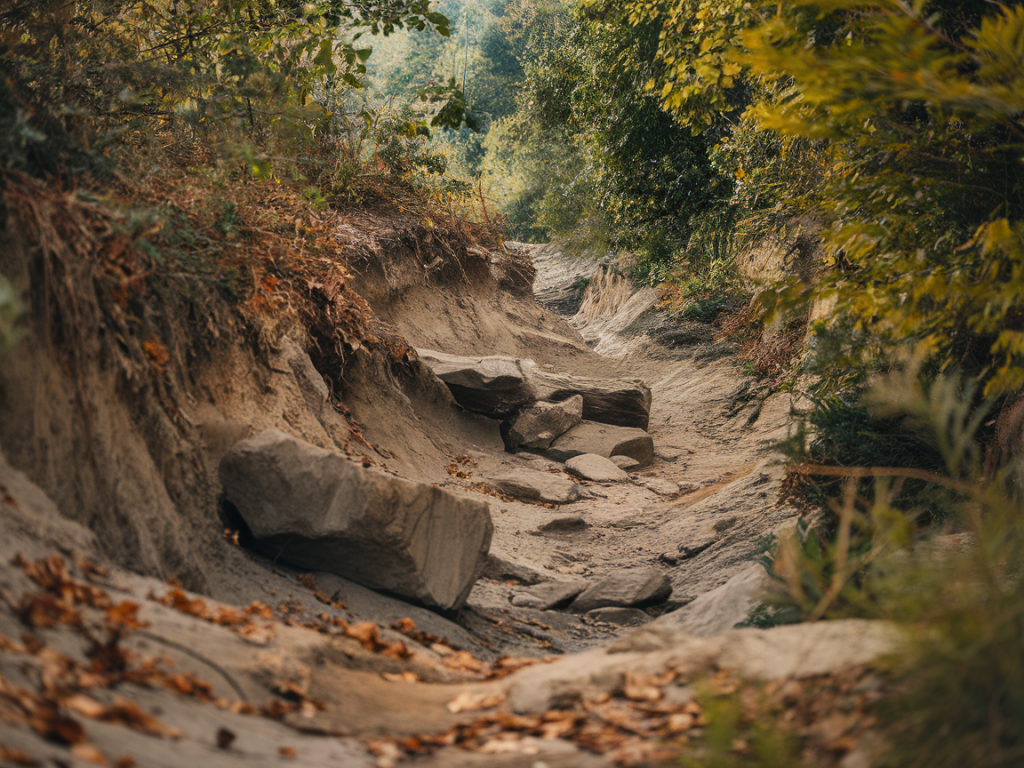
Paths are the arteries of the landscapes I love. Walk them enough and you start to notice small changes — a new rut in the turf, a muddy ribbon widening across a slope, or stones pushed aside to make a shortcut. Left unchecked, these minor shifts become entrenched erosion: deeper channels, lost vegetation and damaged habitats. Over the years I’ve learnt to spot the early warning signs of path erosion and to report them in ways that actually help local volunteer groups act. Below I share what I look for on the trail, how to document problems clearly, and how to get in touch with the right people so repair work can happen swiftly and with minimal impact.

What I look for first: subtle, telling signs

When I’m out on a walk I move slowly and use my camera as a tool for observation as much as for pictures. These are the signs that make me pull out my notebook or phone:

  • Shallow ruts and channels — narrow gullies running along the path, often caused by concentrated runoff. If the path has a slight fall and the surface is compacted, rainwater can start to carve a channel.
  • Edge creep — the path becoming wider as walkers skirt muddy sections. Look for vegetation trampling at the margins: it’s the first step towards a braided, wider path.
  • Step erosion — on slopes where the path has worn into a stepped profile. Steps can be naturalised, but steep, hard-edged treads show accelerated wear.
  • Exposed roots and stones — once the organic cover is lost, roots and rocks stick up and cause people to avoid them, creating new lines next to the original.
  • Scarred vegetation and bare soil — small patches of bare soil near the path indicate widening, particularly around corners or viewpoints.
  • Signs of diverted flow — puddles and water ponding on the path where drainage was once good. This often precedes deeper erosion.
  • When I spot any of these, I note the location and take photographs from multiple angles — upstream and downstream for channels, and a close-up for texture, plus a wider shot to show context. A photo beats description every time.

    How to document erosion effectively

    Volunteers who maintain trails are busy; clear, consistent information makes their work easier. I use the following checklist on my phone:

  • Exact location — grid references if you have them (OS grid or GPS), or a clear description (e.g. “2.1 km from car park, near gate post with red paint”). Smartphone map pins are ideal.
  • Photos — at least three: a close-up of the damage, a mid-range shot showing the path width and condition, and a wide shot showing surroundings and orientation. Use landscape orientation for wide shots.
  • Severity rating — a simple scale helps: low (minor widening, little bare soil), medium (braiding, exposed roots, shallow channels), high (deep gullies, undermined banks, major water flow).
  • Contextual notes — recent heavy rain, livestock presence, events, or construction nearby.
  • Your contact details — optional, but helpful if volunteers need clarification.
  • A small table I often use in a report looks like this:

    Field Example
    Location OS Grid: NY123456 / 53.8072N, -2.7356W / 1.2 km along Black Cliff Path from car park
    Photos IMG_20250710_1001.jpg (close); IMG_20250710_1002.jpg (mid); IMG_20250710_1003.jpg (wide)
    Severity Medium — braided path, exposed turf at edges
    Notes Recent stormfall, water running down path after rain

    Where and who to report to

    Knowing the right contact depends on where you are. My usual route is:

  • Local volunteer groups — search for the nearest Friends of... group, parish path maintenance team, or a local mountain/footpath association. These groups often run regular work parties and will prioritise problems for safety and habitat protection.
  • National organisations — if it’s a National Trust, National Park, Forestry England or similar landowner you can usually report issues via their websites or ranger services.
  • Local council — for public rights of way in urban or parish areas, rights-of-way teams at district councils often handle repairs or coordinate volunteers.
  • I always try to find a named contact — a volunteer co-ordinator, ranger or rights-of-way officer. A direct email or message to a WhatsApp group will get a quicker response than a generic web form.

    How to phrase a helpful report

    I keep messages short, factual and polite. Volunteers receive a lot of messages and the ones they act on are clear and actionable. Here’s a template I use and adapt:

  • Subject: Path erosion report — Black Cliff Path (1.2 km from car park)
  • Message: Hello — I walked the Black Cliff Path today (10 July). There is medium-level erosion c.1.2 km from the car park near the stile (OS Grid NY123456). The path is braided and turf is starting to fail on the outer edge. Photos attached (close/mid/wide). Water appears to be running down the line after rain. Happy to provide GPS pin if useful. Thanks for your work — Mathis
  • Including the severity assessment and photos means volunteers can judge what kit and materials — hoppers, timbers, aggregate — might be required.

    Small actions walkers can take in the moment

    While reporting, there are things I do to reduce further damage:

  • Use the existing worn line rather than creating an alternative: stepping around a muddy patch widens the track.
  • Where possible, walk on the crown of a path rather than the very edge, to avoid trampling recovering vegetation.
  • Avoid cutting corners or making new tracks; this is how braiding starts.
  • Stick to stiles and gates rather than squeezing through hedges — repeated squeezing creates new erosion lines.
  • I mention kit here because a simple pair of gaiters or waterproofs (for example, Rab or Montane) keeps you comfortable so you’re less likely to take evasive routes. A compact trowel or small saw isn’t necessary for most walkers — leave repairs to trained volunteers.

    What volunteer groups do next — and how you can help further

    Once a report reaches the right people, volunteers typically do a site visit to assess cause and priority. Remedies range from small-scale re-turfing and installing simple water bars to more substantial stone pitching or boardwalks. If you want to do more than report, ask how you can help: many groups welcome extra pairs of hands on workdays, or donations to cover materials.

    Reporting early is the best conservation step any walker can take — it keeps paths safe, protects the vegetation beside them, and makes maintenance more manageable and affordable. If you send clear information and photos, you’ll be surprised how quickly a local group can respond.

    You should also check the following news: