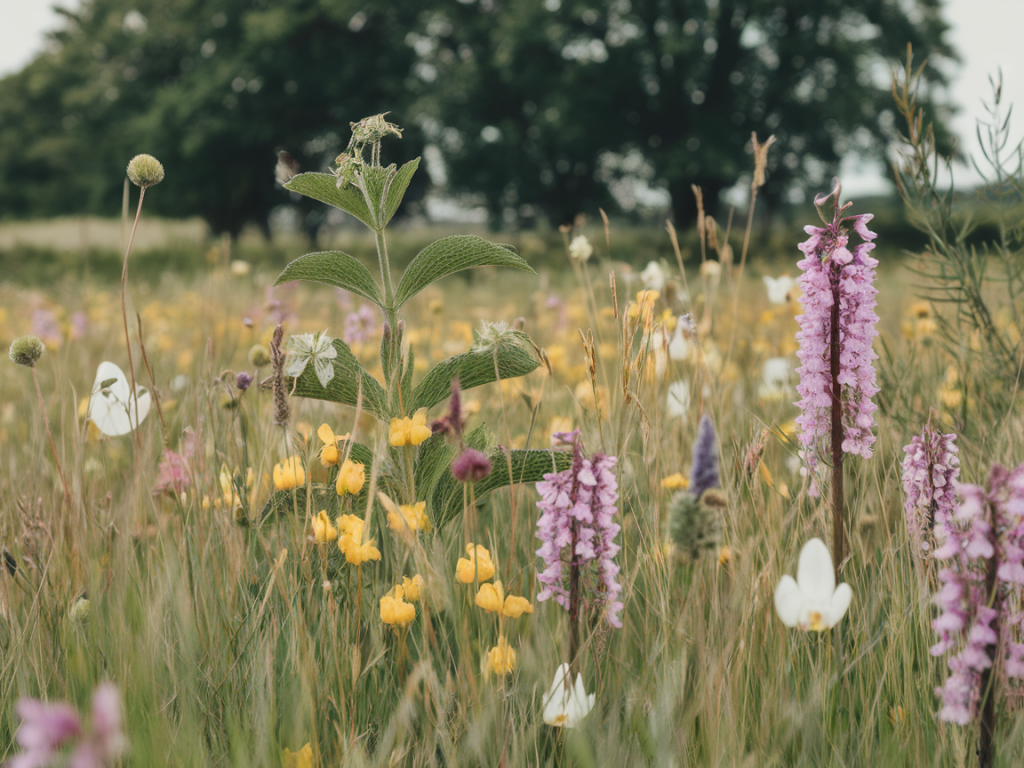
I’m drawn to the edges — where field meets scrub, verge meets meadow, and the thin slice of marginal ground seems to hum with life. On short walks close to home I look for those thin threads of wildflower habitat that punch above their weight for pollinators: a roadside bank of hemp-nettle, a grazed chalk down with ox-eye daisies, the patchy turf where bee orchids pop up. These are the places most walkers pass without thinking, but given a little attention they become small, rich festivals of insect life.
Why marginal habitats matter
Marginal habitats — road verges, disused railway embankments, field margins, quarry edges and coastal shingle — are often dismissed as leftovers. In reality they can be refuges for a surprising variety of wildflowers. The reasons are simple: disturbance prevents scrub takeover, low-intensity management allows flowers to seed, and heterogeneous soil conditions suit specialist plants. For pollinators these patches are stepping stones across a landscape otherwise dominated by intensive agriculture.
Short walks that pay dividends
Below are a few walk ideas you can fit into a morning or an afternoon. I’ve kept them short and flexible: aim for 2–6 km, walk slowly, and focus on the margins and verges rather than trying to cover distance. These routes are described in a general way so you can find similar habitats near you.
Spotting the three stars: hemp-nettle, ox-eye and bee orchid
Here’s a quick reference to help you identify these species and understand their preferred niches.
| Species | Key features | Flowering time | Typical habitat |
|---|---|---|---|
| Hemp-nettle (Galeopsis spp.) | Pink/purple tubular flowers, hairy stems and leaves; looks nettle-like but not stinging | Late spring to summer (May–Aug) | Disturbed ground, field margins, verges, track edges |
| Ox-eye daisy (Leucanthemum vulgare) | Large white rays with yellow disc; single-stemmed clumps; attracts bees and butterflies | Late spring to mid-summer (May–July) | Meadows, road verges, rough pasture, downland |
| Bee orchid (Ophrys apifera) | Intricate, bee-mimicking flower; pink sepals and patterned lip; solitary or small clumps | Late spring (May–June) | Thin, calcareous turf, quarry edges, roadside banks on chalk/limestone |
When to go and what to expect
Timing matters. For early-inspecting pollinators go out on warm, still mornings from late spring through early summer. Bee orchids are at their best in late May and June; ox-eyes light up fields from late May into July; hemp-nettles appear through the summer and can be particularly obvious on disturbed ground in June–August.
Weather plays a role too. Insects are most active when the sun is out and temperatures are above roughly 15°C. A still, sunny morning will bring bees, bumblebees and butterflies to flowers; in cooler, breezier conditions you’ll see less movement and fewer visitors.
How to observe without harming
I’m careful with these places — many are small and easily damaged. Here’s my etiquette, condensed into practical behaviours you can adopt:
Practical kit for short wildflower walks
For these trips I usually carry lightweight layers, a small daypack and a compact kit list that keeps me nimble but ready for photography and recording sightings:
What to look for in pollinator behaviour
Observing how insects use flowers is rewarding and teaches you what plants are most valuable. Watch for:
Simple things you can do to help
Even short walks can turn into small acts of conservation. Carry out a few simple habits and spread the idea:
I’ve written more detailed route guides and gear recommendations on Borderhike Co (https://www.borderhike.co.uk), where you’ll find photographic notes and seasonal tips to plan these kinds of short, rewarding walks. Step out slowly, look low and close, and you’ll be surprised how much colour and insect life a few marginal metres can hold.